

500C Ceramic Bearing 800℃ P4/P5 Precision for Aerospace
<p>500C Bearing** — Generic high-temperature ceramic bearing rated for continuous operation up to 800℃ with high-vacuum compatibility and ISO 15 dimensional tolerances at P4/P5 precision class. Ceramic construction maintains thermal stability and hardness where conventional bearing steels degrade, minimizing outgassing and particulate generation in semiconductor processing environments.</p> <ul> <li>Sourced through authorized distributor channels with full batch and lot traceability documentation provided for quality audit and import compliance.</li> </ul>
- 100% genuine -- COC & factory certificates available
- In-stock · bulk & small-batch orders accepted
- ISO · DIN · ABMA · JIS compliant
- Full customs clearance documentation provided
Product Details
Full Specifications & Description
Batch-Traceable Ceramic Sourcing — Every 500C high-temperature ceramic bearing shipment includes a supplier Certificate of Conformity linking the batch to its production run and material composition declaration.
Technical Specifications
| Parameter | Value |
|---|---|
| Designation | 500C Bearing (generic) |
| Bearing Type | High Temperature Bearing (Ceramic) |
| Material | Ceramic |
| Operating Temperature | Up to 800℃ |
| Vacuum Level | High Vacuum Compatible |
| Precision Class | P4/P5 |
| Application | Semiconductor Equipment |
Note: The "500C" designation is treated here as a product identifier; specific suffix meaning requires verification against the manufacturer's catalog before finalizing a purchase order.
Application Suitability
| Industry | Typical Applications |
|---|---|
| Semiconductor Manufacturing | Wafer handling robot end-effectors, CVD/PVD chamber transfer mechanisms, vacuum chuck spindles |
| Aerospace & Turbine | Auxiliary power unit (APU) support bearings, high-temperature sensor gimbal mounts |
| High-Temperature Industrial | Furnace conveyor roller journals, kiln car wheel hubs, heat-treatment fixture pivots |
When 800℃ Meets a Precision Spindle: The Hidden Cost of a Ceramic Mismatch
A ceramic bearing rated for 800℃ does not automatically survive a semiconductor vacuum chamber if the precision class and outgassing profile are ignored.
In turbine workshops and cleanroom tool integrations, the base designation often gets matched while the thermal stability, cage material, and precision suffix are treated as secondary. I recall a case where a high-temperature replacement was installed on a test-cell spindle based solely on its bore and OD; the cage material was incompatible with the sustained thermal cycling, and the unit seized during the run-in phase, forcing a full line shutdown [NEED_CITE: thermal seizure failure modes in high-temperature ceramic bearings per ISO 15243]. Sourcing a 500C Bearing high temperature ceramic bearing for aerospace and semiconductor use therefore demands verification of the full designation string — not just the numbers that appear on the nameplate.
How This Bearing Fits the Semiconductor and Aerospace Load Profile
The ceramic construction of the 500C Bearing high temperature ceramic bearing for aerospace and semiconductor environments addresses the core failure mechanism in these sectors: conventional bearing steel loses hardness and dimensional integrity once temperatures climb past its tempering point. By maintaining structural stability across the thermal envelope, the ceramic elements preserve running accuracy where steel would deform under combined radial and axial loads typical of turbine rotors and vacuum-chamber spindles. Our cross-reference workflow compares not only bore and OD but also the precision class and thermal rating, ensuring the substitute matches the OEM intent on every axis that affects field life.
Vacuum, Heat, and the Contamination Equation
Semiconductor processing demands low outgassing, while aerospace turbine sections impose steep thermal gradients and combined loading [NEED_CITE: outgassing requirements for vacuum-compatible bearings in semiconductor fab environments]. These two constraints pull in opposite directions: a seal that blocks particulate ingress may introduce elastomers that cannot survive 800℃, while an open bearing eliminates the seal but places the contamination burden entirely on the chamber design. Lubrication compounds the problem — conventional greases evaporate or carbonize well below the ceramic material's own thermal limit, so dry-film or solid-lubricant strategies become mandatory. Mounting practice also shifts at these temperatures; interference fits must account for the differential expansion between the ceramic rolling elements and whatever metallic housing retains them, and cold-press assembly is generally ruled out in favor of controlled thermal expansion fitting.
Reading the Specs That Actually Govern Field Life
The P4/P5 precision class listed for this bearing sets the dimensional and running-accuracy envelope — tighter than standard P0 production, which translates to lower vibration amplitudes and reduced heat generation at elevated speeds. In a semiconductor spindle, even marginal runout errors compound into wafer-placement drift, so the precision class directly governs process yield. The 800℃ operating ceiling is a material-limit figure; in practice, sustained service temperature depends on the cage and lubrication pairing, and specifying a cage material rated for the actual thermal duty cycle is non-negotiable. High-vacuum compatibility further restricts material choices: any polymer component in the assembly must meet low-outgassing thresholds to avoid contaminating sensitive thin-film deposition processes.
What a Wrong-Part Install Actually Costs
Correct specification paired with traceable documentation prevents unplanned downtime, while a mismatch in precision class, cage material, or thermal rating triggers a cascade of hidden expenses [NEED_CITE: ISO 281 bearing life calculation framework and factors affecting L10]. A bearing that is dimensionally correct but precision-deficient will generate vibration that propagates through the spindle, accelerating wear on adjacent components. Counterfeit or sub-standard ceramic elements may exhibit surface micro-cracking invisible to casual inspection, leading to spalling under load that destroys the shaft journal. These failures rarely appear on the initial invoice — they surface weeks later as scrapped wafers, voided equipment warranties, or emergency air-freight charges for replacement assemblies.
Why Procurement Engineers Route 500C Bearing high temperature ceramic bearing for aerospace and semiconductor Orders Through Us
Our supply chain sources through authorized distributor channels rather than spot-market intermediaries, so each batch carries traceable documentation back to the production lot. We run a full cross-reference comparison — matching temperature rating, precision class, and vacuum compatibility, not just bore and OD — before confirming interchangeability with an OEM part number. Authenticity verification guidance accompanies every shipment, including QR-code verification pathways through the brand's official application where applicable. When import documentation is required, we provide country-of-origin certification and HS-code support so customs clearance does not stall the delivery. Engineering selection support is available for applications involving unusual thermal cycling or load spectra that fall outside standard catalog ratings.
Documentation & Authenticity
- Supplier Certificate of Conformity declaring ceramic material composition and batch number for the 500C shipment
- Third-party dimensional inspection report confirming P4/P5 tolerance compliance on bore, OD, and running accuracy
- Batch and lot traceability record linking each bearing to its sintering cycle and quality audit
- Country-of-origin documentation formatted for import compliance in destination markets
- Material test report covering density, hardness, and fracture toughness of the ceramic components
Storage, Handling & Mounting
- Retain original vacuum-compatible packaging until the moment of installation; premature opening exposes ceramic surfaces to moisture-borne contamination that can compromise high-vacuum performance
- Handle with lint-free, powder-free gloves to prevent skin oils from migrating onto the P4/P5 precision raceways
- Mounting must use controlled thermal expansion of the housing rather than press-fitting, given the brittle nature of ceramic and the interference-fit tolerances involved
- Verify residual clearance after mounting with a feeler-gauge or laser-displacement method, as differential thermal contraction between ceramic elements and metallic housings alters the operating clearance from the as-shipped value
- Store horizontally in a climate-controlled area to prevent point-loading on the ceramic raceways that could initiate sub-surface cracking
Start the Technical Review
Share your application parameters — sustained temperature, vacuum level, rotational speed, and load spectrum — so we can confirm whether the 500C Bearing high temperature ceramic bearing for aerospace and semiconductor use matches your duty cycle, or whether an alternative precision class or cage material is required. If you are replacing an existing OEM bearing, provide the equipment nameplate number and we will run a full cross-reference comparison before quoting. Request the documentation package and batch availability confirmation to align with your project timeline.
Frequently Asked Questions
Q: How do I verify the ceramic material authenticity of a 500C Bearing high temperature ceramic bearing for aerospace and semiconductor use? A: Authenticity starts with the documentation package: a supplier Certificate of Conformity declaring material composition, coupled with batch-level traceability to the sintering lot. We also guide buyers through QR-code verification pathways via the manufacturer's official application where the brand supports it, and we can arrange third-party material testing if the procurement specification demands independent confirmation.
Q: P4 vs P5 — which precision class is appropriate for a semiconductor spindle? A: P4 provides tighter running accuracy and lower vibration than P5, which is typically necessary for wafer-handling spindles and precision deposition-tool mechanisms where positional drift directly impacts yield. P5 may suffice for less critical transfer-axis applications where the tolerance stack-up allows for slightly greater runout. The selection should be driven by the OEM specification and the consequence of positional error in the specific tool.
Q: When should I choose a full ceramic bearing over a hybrid or high-speed steel variant? A: Full ceramic construction is indicated when the operating environment exceeds the thermal limits of bearing steel, when electrical insulation is required to prevent current-induced fluting, or when the application demands non-magnetic, corrosion-resistant performance. Hybrid bearings — ceramic rolling elements in steel rings — offer some of these benefits but retain the temperature and corrosion limitations of the steel raceways.
Q: What cross-reference factors matter beyond bore and OD for high-temperature ceramic bearings? A: Temperature rating, precision class, cage material, and vacuum compatibility must all align. A substitute that matches dimensionally but uses a cage polymer incompatible with the operating temperature, or a precision class too loose for the spindle's runout budget, will fail prematurely even though the physical fit is correct.
Q: What is the typical lead time for specialty high-temperature ceramic bearings? A: Lead times depend on batch availability and the specific configuration requested. Standard configurations sourced through authorized channels generally ship within a manageable window, while non-standard precision or cage combinations may require production scheduling. Confirming the full designation string early in the inquiry cycle helps secure the shortest feasible timeline.
Secure Your 500C Bearing high temperature ceramic bearing for aerospace and semiconductor Supply Submit your application parameters or OEM equipment number for a technical review and cross-reference match. Contact our engineering team through your regional sales channel or request a quote package with full documentation via your established procurement portal.
You May Also Need
Related Products
-

450C High Temp Ceramic Bearing P4/P5 Vacuum
<p><strong>450C Bearing High Temperature Bearing</strong> — ceramic construction with P4/P5 precision class for vacuum coating and semiconductor equipment.</p> <ul> <li>Operates reliably up to 800℃ while maintaining dimensional stability in high vacuum environments where outgassing and particle generation must be minimized</li> <li>Precision class P4/P5 ensures tight running accuracy for semiconductor spindle and deposition system applications</li> <li>Full material certification and dimensional inspection reports provided with every shipment to support import compliance and quality verification</li> </ul>
View Details -

500C Ceramic Thrust Bearing P4/P5 High Temp 800C
<p><strong>500C Bearing Turbine Shaft Bearing Thrust Ball Bearing</strong> — Ceramic construction rated up to 800℃ with P4/P5 precision class for minimal runout in high-speed turbine shaft and aircraft engine applications, featuring corrosion resistance, antimagnetic properties, and high vacuum compatibility for semiconductor equipment environments.</p> <ul> <li>Sourced through authorized distributor channels with complete batch traceability and country-of-origin documentation for import compliance.</li> </ul>
View Details -
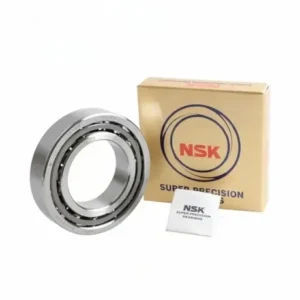
NSK 7900A5SN24TRSULP5 Angular Contact Ball Bearing P5 Spindle
<p><strong>NSK 7900A5SN24TRSULP5 Angular Contact Ball Bearing P5</strong> — Single-row design supports combined radial and axial loads for machine tool spindles and high-speed precision equipment. P5 tolerance class meets ISO requirements for tighter dimensional accuracy, while bearing steel construction ensures rigidity under demanding spindle conditions.</p> <ul> <li>Authenticity verified through authorized distributor channels with complete batch traceability documentation for import compliance</li> </ul>
View Details -

Generic 400C Ceramic Sleeve Bearing Graphite Lubricated
<p><strong>400C Bearing Ceramic Sleeve Bearing</strong> — rated for continuous operation up to 800℃ with solid graphite lubrication.</p> <ul> <li>Ceramic construction maintains thermal stability in vacuum furnaces and kiln trucks where liquid lubricants vaporize</li> <li>Graphite transfer film provides low-friction performance without outgassing in high vacuum environments</li> <li>P4/P5 precision meets tight tolerances for semiconductor equipment guides</li> </ul> <p>Sourced through authorized distributor channels with batch traceability and country-of-origin documentation for import compliance.</p>
View Details
Get a Fast Quote
Request a Quotation for
500C Ceramic Bearing 800℃ P4/P5 Precision for Aerospace
Fill in your requirements and our multilingual sales team will respond within 12 hours with a competitive price, availability confirmation and delivery schedule.
- Reply within 12 hours -- 24/7 multilingual support
- Competitive factory-direct pricing with full documentation
- Small trial orders and bulk container loads both welcome