
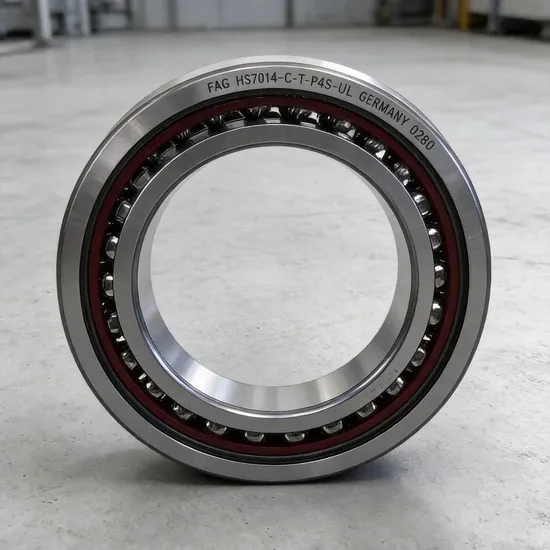
FAG B7204-E-T-P4S Angular Contact Bearing P4S Precision
<p><strong>FAG B7204-E-T-P4S Angular Contact Ball Bearing 20×47×14 mm P4S</strong> — engineered for machine tool spindles requiring ISO class 4 running accuracy with minimal runout under combined radial and axial loads. Single-row configuration with standardized envelope dimensions supports direct replacement in precision spindle housings.</p> <ul> <li>Sourced through authorized distributor channels with batch and lot traceability documentation for import compliance.</li> </ul>
- 100% genuine -- COC & factory certificates available
- In-stock · bulk & small-batch orders accepted
- ISO · DIN · ABMA · JIS compliant
- Full customs clearance documentation provided
Product Details
Full Specifications & Description
Traceable Supply Chain — Every FAG B7204-E-T-P4S we ship arrives with full Certificate of Conformity documentation tied to its production batch, so you can trace it back through authorized distributor channels before it ever reaches your spindle housing.
Technical Specifications
| Parameter | Value |
|---|---|
| Designation | FAG B7204-E-T-P4S |
| Bearing Type | Angular Contact Ball Bearing (Spindle Series) |
| Bore Diameter (d) | 20 mm |
| Outside Diameter (D) | 47 mm |
| Width (B) | 14 mm |
| Number of Rows | Single Row |
| Contact Angle | 25° (E suffix) |
| Precision Class | P4S (ISO class 4 with running accuracy supplement) |
| Bore Type | Cylindrical |
| Arrangement | Single bearing (universal mounting) |
| Weight | 0.100 kg |
| Origin | China |
| Seal or Shield Type | Open |
| Cage Material | Phenolic resin, outer-ring guided (T suffix) |
| Clearance Class | Standard spindle preload pairing |
Note: The E and T suffixes denote FAG-specific internal design and cage configuration; precise cage guidance method and internal geometry details should be confirmed against the manufacturer catalog for critical high-speed applications.
Application Suitability
| Industry | Typical Applications |
|---|---|
| Machine Tool Manufacturing | Internal grinding spindles, milling head spindle cartridges |
| Precision Equipment | Optical measuring instrument rotary tables, CMM air-bearing replacements |
| Robotics | High-speed harmonic drive output joints, articulated arm pitch axes |
What Happens When the Suffix Gets Ignored on a 20 mm Spindle Bearing
A base number match without suffix verification is a field failure waiting for its first thermal cycle.
In my early procurement years at a Jinan machine shop, I approved a spindle rebuild where we matched the 7204 size but missed the "T" cage designation. The substitute cage couldn't manage the thermal load at sustained high RPM, and the phenolic material delaminated during the 72-hour run-in test. That single oversight cost us a three-week rebuild cycle and a customer relationship that took months to repair. The FAG B7204-E-T-P4S angular contact ball bearing carries suffixes that define its thermal behavior, cage stability, and running accuracy — ignoring any one of them turns a precision component into a liability. Counterfeit bearings flooding the supply chain often replicate the base marking flawlessly but substitute soft inner rings and generic cages that fail catastrophically under real spindle loads. [NEED_CITE: spindle bearing failure modes from cage material substitution per ISO 15243]
Matching the 25° Contact Angle to Your Spindle's Load Profile
The E suffix on the FAG B7204-E-T-P4S angular contact ball bearing indicates a 25° contact angle, which shifts the load-carrying balance toward higher axial rigidity compared to a 15° (C suffix) design. In grinding spindles where axial thrust from wheel engagement dominates the load spectrum, this steeper angle maintains shaft positioning accuracy under cutting forces. We've cross-referenced this configuration against equivalent SKF and NSK spindle series to confirm that substituting a 15° variant in the same housing would reduce axial stiffness noticeably, leading to chatter marks on finished surfaces. Procurement engineers requesting interchange support should always specify whether their application is radial-dominant or thrust-dominant before we confirm an alternative brand.
Thermal Growth, Speed Limits, and Why the T Cage Matters
At sustained speeds approaching the grease-limit threshold, the cage becomes the most thermally stressed component in the bearing. The T suffix on this model designates a phenolic resin cage with outer-ring guidance — a configuration chosen specifically for high-speed spindle duty where minimizing cage mass reduces centrifugal loading on the balls. Temperature rise inside a sealed spindle housing is cumulative: inadequate lubrication intervals, combined with a heavier brass cage substitute, can push internal temperatures past the point where thermal expansion closes the operating clearance entirely. [NEED_CITE: effect of cage material mass on high-speed bearing thermal equilibrium] This is why we verify not just the base model but the cage material code before confirming any cross-brand interchange for spindle applications.
Decoding the P4S Precision Class for Spindle Runout Requirements
The P4S designation combines ISO tolerance class 4 dimensional accuracy with FAG's supplementary running accuracy specification — tighter than standard P4 in the parameters that matter most for spindle runout. In practical terms, this means the inner and outer ring raceway geometry, bore tolerance, and outer diameter all fall within a band that supports sub-micron rotational accuracy when paired with proper shaft and housing fits. Substituting a P5-grade bearing in a grinding spindle cartridge may appear dimensionally interchangeable but introduces radial runout that shows up as visible spiral patterns on machined surfaces. We always confirm the required ISO precision class with the maintenance engineer before quoting, because the price gap between P5 and P4S is minor compared to the cost of a scrapped production batch.
The Hidden Cost of a "Close Enough" Substitute
Correct specification matched with genuine sourcing documentation versus a convenience-driven substitution creates two entirely different lifecycle cost profiles. A bearing that meets P4S running accuracy and arrives with verifiable batch traceability supports predictable L10 life calculations per ISO 281. A counterfeit or mis-specified unit — wrong clearance, generic cage, soft raceway material — may physically fit the housing but introduces failure modes that fall outside standard warranty coverage. Premature spalling, cage fragmentation, and thermal seizure are all classified under ISO 15243 failure categories, and every one of them triggers unplanned downtime that dwarfs the original component cost. [NEED_CITE: unplanned downtime cost multiplier in precision manufacturing environments]
How We Support Spindle Bearing Procurement Differently
Every FAG B7204-E-T-P4S angular contact ball bearing we source moves through authorized distributor channels with batch-level traceability — not open-market spot purchases where provenance disappears after the first resale. When a procurement engineer sends us an OEM equipment number rather than a bearing model, we cross-reference not just the base designation but the clearance class, cage material, and precision suffix to confirm the substitute will perform identically in the field. Our documentation package travels with the shipment: Certificate of Conformity, dimensional inspection data, and origin paperwork formatted for import compliance in Middle East, African, and Latin American customs regimes. For buyers who've been burned by cloned QR codes and soft-ring counterfeits, we walk through the brand's official app verification pathway so authenticity is confirmed before the bearing leaves its packaging.
Documentation & Authenticity
- Supplier Certificate of Conformity linked to the specific production batch and lot number of your FAG B7204-E-T-P4S shipment
- Third-party dimensional runout inspection confirming P4S running accuracy prior to dispatch, not just catalog-claimed tolerance
- QR code verification pathway via the brand's official mobile application, with guidance on identifying cloned codes that pass casual visual checks
- Country-of-origin documentation prepared for import filing, including HS code classification for angular contact ball bearings
- Material certificate confirming ring and ball metallurgy consistent with FAG spindle bearing specifications
Storage, Handling & Mounting
- Retain the factory-sealed packaging until the moment of mounting; early exposure to ambient humidity compromises the corrosion-inhibiting coating on the open-type raceways of this P4S spindle bearing
- Handle exclusively with lint-free gloves — fingerprint acids etch the precision-ground raceway surfaces and create initiation sites for micropitting under high-speed operation
- For spindle cartridge assembly, follow the manufacturer's preload pairing marks and mounting sequence; incorrect axial clamping order on a single-row angular contact bearing reverses the intended thrust direction
- Store horizontally in a temperature-stable environment (avoid unheated warehouses where condensation cycles form overnight) to preserve the phenolic cage's dimensional stability before installation
- Apply only the spindle manufacturer's specified grease type and fill quantity — over-greasing an open-type 20 mm bore spindle bearing generates churning heat that negates the T cage's high-speed advantage
Ready to Specify Your Spindle Bearing Requirement
Share your spindle application parameters — operating speed, load spectrum, housing fit tolerances, and lubrication method — and we'll confirm whether the FAG B7204-E-T-P4S angular contact ball bearing matches your requirements or whether a different suffix configuration serves you better. If you're working from an OEM equipment number rather than a bearing designation, send that along and we'll run the full cross-reference check including clearance, cage, and precision alignment before quoting.
Frequently Asked Questions
Q: How do I confirm that a FAG B7204-E-T-P4S sourced through a third-party channel is genuinely authentic? A: Request the batch and lot number from your supplier and verify it through the brand's official mobile application using the QR code on the packaging. We provide this traceability chain with every shipment, along with a Certificate of Conformity that ties the physical bearing to its production batch. Counterfeit units often replicate markings convincingly but fail the app-based verification because their serial numbers don't resolve in the manufacturer's database.
Q: What exactly does the P4S precision class mean compared to standard P4 or P5 for my spindle application? A: P4S builds on ISO tolerance class 4 dimensional accuracy by adding tighter running accuracy constraints — specifically the parameters that govern rotational runout under load. For grinding and high-speed milling spindles, this tighter running accuracy translates directly to surface finish quality on the workpiece. A P5 substitute may mount without issue but introduces radial and axial runout that becomes visible as chatter or spiral marks on finished parts.
Q: Can I substitute another brand's angular contact bearing for the FAG B7204-E-T-P4S in my existing spindle housing? A: Cross-brand interchange is possible, but it requires matching three elements simultaneously — not just the base 7204 size, but the 25° contact angle (E suffix equivalent), the phenolic cage material (T suffix equivalent), and the P4S precision level. We provide a complete cross-reference comparison across SKF, NSK, and other major brands that aligns all three parameters, so the substitute performs identically in your application without trial-and-error field testing.
Q: Why does the cage material designation (T suffix) matter for a spindle running at high RPM? A: The phenolic resin cage designated by the T suffix is significantly lighter than a brass alternative, reducing centrifugal forces on the cage itself at high rotational speeds. This lower mass also means less frictional heat generation, which is critical in sealed spindle cartridges where heat dissipation is limited. Substituting a heavier cage material without adjusting the speed limit can accelerate cage wear and shorten the bearing's service interval noticeably. [NEED_CITE: relationship between cage mass and speed limit in angular contact spindle bearings]
Q: What documentation should I expect when importing this bearing for industrial use? A: A complete documentation package includes the Certificate of Conformity, dimensional inspection report, material certificate, and country-of-origin paperwork formatted for customs clearance. We also provide HS code guidance specific to angular contact ball bearings to prevent misclassification delays at the port of entry. For regions with strict anti-counterfeit import controls, the batch traceability documentation serves as evidence of authorized-channel sourcing.
Confirm Your Spindle Bearing Specification Today
Send us your spindle speed, load conditions, and OEM equipment number — we'll verify the correct suffix configuration and return a fully documented quotation with confirmed lead time. Contact our technical sourcing team to begin your inquiry.
You May Also Need
Related Products
-
 SKF
SKF
Rodamiento de bolas de contacto angular de doble fila 3307 A-2Z <p>/<strong> para equipos de transmisión con jaula de acero
<p>Enhance transmission equipment reliability with the <strong>SKF 3307 A-2Z TN9/MT33 Double Row Angular Contact Ball Bearing</strong>, designed to deliver consistent performance under radial and axial loads. Its steel cage construction ensures durability in high-speed applications, while the double row design minimizes vibration for smoother operation—ideal for maintaining precision in critical machinery.</p><ul><li>Engineered with TN9/MT33 clearance and lubrication specifications to reduce maintenance downtime and extend service life</li><li>2Z metal shields provide effective contamination protection, ensuring reliable operation in industrial environments</li><li>Directly sourced from SKF official channels for guaranteed authenticity and complete batch traceability</li></ul>
View Details -
 SKF
SKF
Rodamiento de bolas de contacto angular de doble fila 3305 A-2Z <p>/C3 <strong> para uso industrial a alta temperatura
<p>Ensure reliable high-temperature industrial operations with the <strong>Double Row Angular Contact Ball Bearing 3305 A-2Z TN9/C3 VT113</strong>, engineered to deliver consistent performance in demanding thermal environments. This SKF bearing combines double-row angular contact design with VT113 high-temperature tolerance, eliminating unexpected downtime caused by heat-related bearing failure in critical equipment like steel mill rollers or automotive production lines.</p><ul><li>Precision-machined steel cage maintains structural integrity under extreme temperatures, ensuring smooth load distribution and extended service life</li><li>2Z shielded construction prevents contamination while allowing for optimal grease retention, reducing maintenance intervals for industrial machinery</li><li>C3 clearance rating accommodates thermal expansion, making it ideal for applications with fluctuating temperature conditions</li></ul>
View Details -
 SKF
SKF
Double Row Angular Contact Ball Bearing 3303A Tn9/C3 Nylon Cage for Compressor Transmission
<p>Ensure reliable compressor transmission with consistent performance using our <strong>SKF 3303A Tn9/C3 nylon cage bearing</strong> — designed to minimize operational downtime and maintain precision under radial and axial loads. This double row angular contact ball bearing features a durable nylon cage that reduces friction and heat buildup, extending service life in high-speed compressor applications.</p><ul><li>Engineered for seamless power transfer with separated inner/outer rings for easy mounting and alignment</li><li>Precision-grade bearing steel construction ensures original SKF quality and traceability</li><li>Optimal lubrication retention through specialized design, ideal for continuous-duty compressor systems</li></ul>
View Details -
 SKF
SKF
Rodamiento de bolas de contacto angular de doble fila 3211-A P4 para maquinaria de alta velocidad <p>
<p>Ensure high-speed machinery operates with precision and reliability using the <strong>Double Row Angular Contact Ball Bearing 3211-A P4</strong> from SKF. Engineered for dynamic performance, this bearing minimizes vibration and extends equipment lifespan in critical applications like precision spindles and high-speed rotating systems.</p><ul><li>P4 precision rating ensures exceptional rotational accuracy, reducing noise and energy loss during high-speed operations</li><li>Double row angular contact design delivers superior radial and axial load capacity, maintaining stability even under fluctuating workloads</li><li>Constructed with premium bearing steel and available with steel, copper, or nylon cages to match specific application demands</li><li>Directly sourced from SKF official channels for guaranteed authenticity and full traceability, eliminating concerns about counterfeit components</li></ul>
View Details
Get a Fast Quote
Request a Quotation for
FAG B7204-E-T-P4S Angular Contact Bearing P4S Precision
Fill in your requirements and our multilingual sales team will respond within 12 hours with a competitive price, availability confirmation and delivery schedule.
- Reply within 12 hours -- 24/7 multilingual support
- Competitive factory-direct pricing with full documentation
- Small trial orders and bulk container loads both welcome