
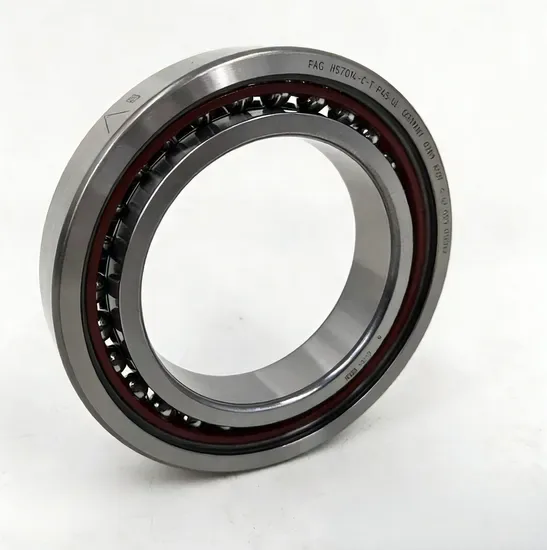
FAG B7202-E-T-P4S Angular Contact Ball Bearing P4 Precision
<p><strong>B7202-E-T-P4S Angular Contact Ball Bearing 15 mm</strong> — P4 precision class ensures minimal runout for machine tool spindles, while the 40° contact angle delivers reliable axial load handling under high-speed operation.</p> <ul> <li>Optimized internal design (E) enhances load distribution and thermal stability</li> <li>Single row configuration suits applications requiring precise axial positioning</li> <li>Sourced through authorized distributor channels with full batch traceability and Certificate of Conformity documentation provided for import compliance</li> </ul>
- 100% genuine -- COC & factory certificates available
- In-stock · bulk & small-batch orders accepted
- ISO · DIN · ABMA · JIS compliant
- Full customs clearance documentation provided
Product Details
Full Specifications & Description
Traceable Sourcing — Every FAG B7202-E-T-P4S we ship arrives with a manufacturer Certificate of Conformity tied to its production batch, ensuring full traceability from the factory floor to your spindle assembly.
Technical Specifications
| Parameter | Value |
|---|---|
| Designation | FAG B7202-E-T-P4S |
| Bearing Type | Angular Contact Ball Bearing |
| Bore Diameter (d) | 15 mm |
| Number of Rows | Single Row |
| Contact Angle | 40° (B suffix) |
| Precision Class | P4S (ISO tolerance class 4 with additional running accuracy) |
| Internal Design | Optimized (E suffix) |
| Weight | 0.040 kg |
| Origin | China |
| Standards | ISO 492 |
Note: The T suffix in B7202-E-T-P4S could not be independently verified against the current manufacturer catalog and should be confirmed with the supplier before final specification lock-in.
Application Suitability
| Industry | Typical Applications |
|---|---|
| Industrial Machinery | CNC milling and grinding spindle assemblies |
| Precision Equipment | High-speed rotary tables and indexing heads |
| Robotics | Joint actuators requiring minimal axial play |
When a Spindle Bearing Fails in Days, Suffixes Are Usually the Culprit
A single wrong suffix on a precision angular contact bearing can turn a planned rebuild into an unplanned line stop.
I learned this the hard way during a spindle rebuild in Dubai. The supplier matched the base number but sent P0 precision with polyamide cages where P4 and ceramic balls were specified. The spindle overheated within days, leaving chatter marks across every workpiece. The workshop owner did not care about the supplier's excuse — he cared about lost production hours and scrapped parts. [NEED_CITE: bearing failure modes from incorrect precision and cage selection per ISO 15243]
A FAG B7202-E-T-P4S angular contact ball bearing ordered without verifying every suffix against the application requirements is no different from ordering the wrong part entirely.
Matching the B7202-E-T-P4S to Spindle Load and Speed Demands
Machine tool spindles demand bearings that hold tight radial and axial positioning simultaneously while running at elevated speeds. The FAG B7202-E-T-P4S angular contact ball bearing carries a 40° contact angle, meaning it handles the combined loads typical of milling and grinding spindles where axial cutting forces are substantial. The P4S precision class delivers the running accuracy that spindle applications require to avoid vibration-induced surface finish defects.
We once cross-referenced a competitor's spindle bearing for a buyer who could not get lead time from their usual channel. Matching the base number was easy, but aligning the contact angle, precision class, and internal geometry is where substitution either works or causes thermal binding within the first shift.
Thermal Behavior and Lubrication in Precision Spindles
Spindle bearings operate in a narrow thermal window. At high speeds, friction heat expands the inner ring and reduces operating clearance. A bearing with insufficient precision will exhibit uneven load distribution across the balls, concentrating stress and accelerating fatigue. [NEED_CITE: thermal expansion effects on bearing internal clearance in high-speed applications]
Lubrication choice — oil-air mist versus grease packing — directly affects the speed limit and thermal equilibrium of the assembly. The open design of this bearing allows integration into the spindle's centralized lubrication circuit, which is standard practice for most CNC machining centers.
Decoding the Suffixes That Define Performance
The B designation establishes the 40° contact angle. This is the steepest standard angle in the angular contact family, prioritizing axial rigidity over speed capability — exactly what a milling spindle needs when axial cutting forces dominate.
The E suffix indicates an optimized internal design. FAG uses this to denote improved load distribution geometry across the rolling elements, which translates to more uniform stress and better stability under the cyclic loading of interrupted cuts.
P4S goes beyond standard P4 (ISO class 4). The additional S specification tightens running accuracy beyond the standard P4 envelope, targeting the minimal radial and axial runout that high-precision spindles demand. This is the difference between a bearing that merely meets dimensional tolerance and one that performs consistently under load at speed.
The Hidden Expense of a Counterfeit or Mis-specified Spindle Bearing
A counterfeit angular contact bearing with a soft inner ring will pass a casual visual check. It may even pass a basic dimensional measurement. But under spindle loads, the raceway deforms prematurely, generating vibration that ruins surface finish and damages the tool holder taper. [NEED_CITE: counterfeit bearing detection methods and supply chain risks]
A precision mismatch — installing a P0 bearing where P4S is required — does not fail catastrophically. It fails gradually, through increasing vibration, worsening surface finish, and eventually a seized spindle that requires a complete rebuild. The bearing itself costs little. The unplanned downtime, scrapped workpieces, and emergency replacement logistics cost orders of magnitude more.
How We Source Precision Bearings Differently
We procure the FAG B7202-E-T-P4S angular contact ball bearing through authorized distributor channels, not gray market intermediaries. Every shipment carries batch-level traceability back to the manufacturer's production facilities.
Our cross-reference database does not stop at the base number. When a buyer needs to substitute brands due to lead time constraints, we verify that the replacement matches on contact angle, cage material, precision class, and internal design — all four must align, or the substitution introduces risk.
We also provide origin documentation and HS code support for buyers managing import compliance across regions where customs authorities scrutinize bearing shipments closely.
Documentation & Authenticity
- Certificate of Conformity referencing the specific production batch of each FAG B7202-E-T-P4S unit
- Manufacturer QR code verification pathway via the official FAG app for on-site authenticity checks
- Third-party runout inspection confirming P4S running accuracy before shipment leaves our facility
- Material certificate documenting the bearing steel specification and heat treatment condition
- Country-of-origin documentation supporting customs clearance and import compliance
- Dimensional inspection report verifying bore, OD, and width against ISO 492 class 4 tolerances
Storage, Handling & Mounting
- Keep the B7202-E-T-P4S in its original sealed packaging until the moment of mounting to protect the precision-ground raceways from humidity and particulate contamination
- Handle with clean, lint-free gloves — fingerprints on a P4S bearing surface introduce corrosive salts that degrade the raceway over time
- Mount using controlled induction heating of the inner ring to the specified temperature range; avoid open flame or uncontrolled heat sources that can alter the heat treatment of the 15 mm bore ring
- For spindle assemblies requiring paired arrangements, mark and maintain the factory orientation of each bearing to preserve the intended preload geometry
- Verify shaft and housing seat tolerances against the manufacturer's recommendations before pressing the 15 mm bore onto the spindle shaft — interference fit errors are the leading cause of early precision bearing failure
Start Your Bearing Specification Review
Request a Technical Quote for the FAG B7202-E-T-P4S
Share your spindle speed range, axial load profile, and required precision class so we can confirm this bearing matches your application — or recommend a more suitable variant from the angular contact series.
Frequently Asked Questions
Q: How do I verify the authenticity of a FAG B7202-E-T-P4S through official channels? A: Each genuine bearing carries a unique QR code that links to the manufacturer's official verification system. Scanning with the official FAG app confirms the production batch, manufacturing location, and whether the specific unit has been flagged as suspect. We recommend verifying every bearing before mounting, especially when sourcing through secondary channels.
Q: When cross-referencing this bearing to another brand, what must align beyond the base number? A: The contact angle, precision class, cage material, and internal design suffix must all match. A bearing with the same 15 mm bore and angular contact configuration but a 25° contact angle instead of 40° will carry different axial load capacity and generate different internal friction characteristics, leading to thermal issues in a spindle designed for the steeper angle.
Q: What is the practical difference between P4 and P4S precision for spindle applications? A: P4 meets ISO tolerance class 4 for dimensional accuracy. P4S adds stricter running accuracy requirements, which control radial and axial runout under operating conditions more tightly. For high-speed spindles where surface finish depends on minimal vibration, P4S provides the additional margin needed.
Q: Why does the 40° contact angle matter compared to 15° or 25° variants? A: The 40° contact angle maximizes axial load capacity at the expense of some speed capability. In milling spindles where axial cutting forces are the dominant load, the 40° angle provides the rigidity needed to prevent deflection and maintain dimensional accuracy of the machined part.
Request Your Documentation Package
Contact us with your application parameters or OEM equipment number to receive a quotation with lead time, MOQ, and the full documentation suite for the FAG B7202-E-T-P4S angular contact ball bearing.
You May Also Need
Related Products
-
 SKF
SKF
Double Row Angular Contact Ball Bearing 3205A-2RS1 Tn9/Mt33 for Motor Assembly with Steel Cage
<p>Ensure smooth motor assembly performance with the <strong>Double Row Angular Contact Ball Bearing 3205A-2RS1 Tn9/Mt33</strong>, designed to deliver reliable radial and axial load handling in high-torque applications. This SKF bearing features a precision steel cage that maintains optimal ball alignment, reducing friction and extending service life for critical motor components.</p><ul><li>Double row angular contact design provides enhanced rigidity and shock resistance, ideal for continuous-duty motor operations</li><li>2RS1 sealing ensures effective contamination protection, minimizing maintenance needs in industrial environments</li><li>TN9/Mt33 cage configuration optimizes heat dissipation, preventing premature wear during peak load conditions</li></ul>
View Details -
 SKF
SKF
Double Row Angular Contact Ball Bearing 3206 A-2RS1 TN9/C3 MT33 for High Load Applications
<p>Ensure smooth, high-load machinery operation with the <strong>Double Row Angular Contact Ball Bearing 3206 A-2RS1 TN9/C3 MT33</strong>, designed to deliver exceptional radial and axial load support for industrial applications. This SKF bearing combines a double row structure with 2RS1 seals to minimize maintenance interruptions, while the TN9/C3 clearance ensures reliable performance under varying temperature conditions.</p><ul><li>Engineered with precision-grade bearing steel and a durable cage design to handle heavy loads in machinery like steel mills and construction equipment</li><li>Direct supply from official SKF channels guarantees 100% authenticity and full traceability, eliminating concerns about counterfeit components</li><li>MT33 lubrication specification provides optimal friction reduction, extending service life for critical equipment</li><li>Same-day shipping available from our extensive inventory, ensuring you receive the bearings you need without delays</li></ul>
View Details -
 SKF
SKF
Double Row Angular Contact Ball Bearing 3203 A-2Z TN9/Mt33 for High Load Machinery
<p>Ensure your high load machinery operates with uncompromising precision and durability using the <strong>SKF 3203 A-2Z TN9/Mt33</strong> double row angular contact ball bearing. Engineered to handle combined radial and axial loads effortlessly, this bearing minimizes downtime and extends equipment lifespan in demanding industrial environments. <ul><li>Double row design delivers exceptional rigidity for high-load applications, reducing vibration and improving operational stability</li><li>2Z steel shields provide reliable contamination protection, ensuring consistent performance even in harsh conditions</li><li>TN9/Mt33 cage configuration optimizes load distribution, enhancing bearing life and maintenance intervals</li></ul> Backed by SKF's global quality assurance and our direct supply chain, you’ll receive a 100% genuine bearing with full traceability—no middlemen, just trusted performance you can count on.</p>
View Details -
 SKF
SKF
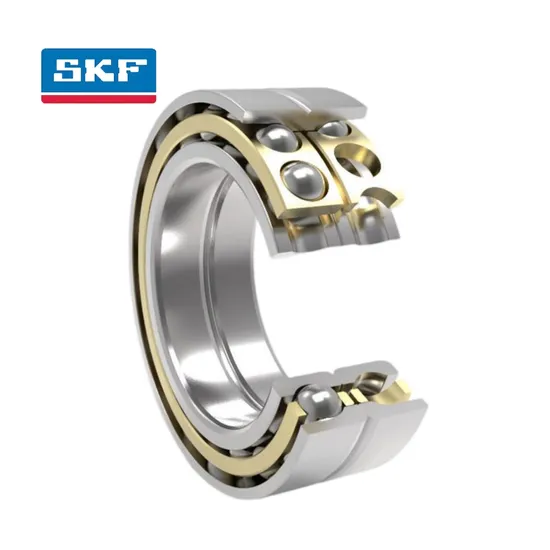
High Speed SKF 3216 A/C3 Double Row Angular Contact Ball Bearing for Motor & Pump
<p>Maximize motor and pump efficiency with the high-performance <strong>SKF 3216 A/C3</strong> double row angular contact ball bearing, engineered to deliver reliable high-speed operation even under demanding industrial conditions. This precision bearing minimizes vibration and extends equipment lifespan, ensuring your critical machinery maintains peak performance with less downtime.</p><ul><li>Double row angular contact design provides superior radial and axial load handling, ideal for motors and pumps requiring both speed and stability</li><li>Manufactured from premium bearing steel with C3 clearance, optimizing heat dissipation for continuous high-speed applications</li><li>Backed by SKF's official warranty and complete traceability, giving you confidence in every installation</li></ul>
View Details
Get a Fast Quote
Request a Quotation for
FAG B7202-E-T-P4S Angular Contact Ball Bearing P4 Precision
Fill in your requirements and our multilingual sales team will respond within 12 hours with a competitive price, availability confirmation and delivery schedule.
- Reply within 12 hours -- 24/7 multilingual support
- Competitive factory-direct pricing with full documentation
- Small trial orders and bulk container loads both welcome