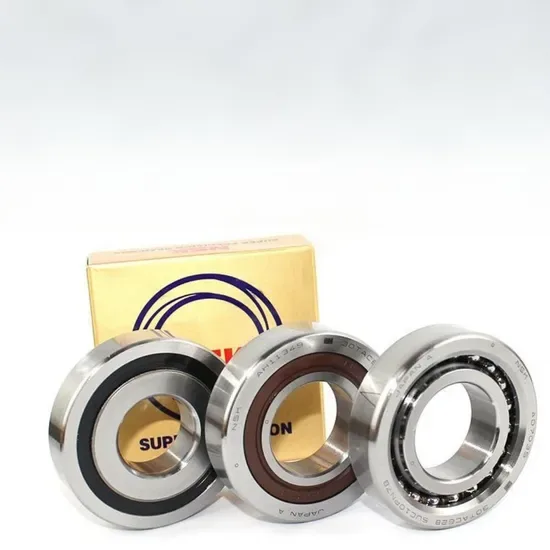
NSK 7900A5TRSUELP3 Angular Contact Ball Bearing P3 Japan
<p><strong>NSK 7900A5TRSUELP3 Angular Contact Ball Bearing</strong> — P3 precision class meets tighter dimensional and running accuracy requirements than P4, suitable for high-speed spindle applications requiring minimal runout. The 15° contact angle generates less friction heat than higher-angle variants under predominantly radial spindle loads.</p> <ul> <li>Sourced through authorized distributor channels with traceable documentation and batch traceability</li> <li>Japan country-of-origin documentation supports import verification and customs compliance</li> <li>Pre-shipment dimensional inspection and Certificate of Conformity provided for every batch</li> </ul>
- 100% genuine -- COC & factory certificates available
- In-stock · bulk & small-batch orders accepted
- ISO · DIN · ABMA · JIS compliant
- Full customs clearance documentation provided
Product Details
Full Specifications & Description
Sourced from authorized distributor channels — every NSK 7900A5TRSUELP3 bearing ships with batch-level documentation traceable back to the manufacturer's production facilities in Japan.
Technical Specifications
| Parameter | Value |
|---|---|
| Designation | NSK 7900A5TRSUELP3 |
| Bearing Type | Angular Contact Ball Bearing |
| Contact Angle | 15° |
| Precision Class | P3 (per ISO 492) |
| Number of Rows | Single Row |
| Bore Type | Cylindrical |
| Origin | Japan |
| Standards Compliance | ISO 492, ISO 15 |
Certain suffix segments in this designation (A5, TR, S, UE) are not fully decoded in open reference materials and should be confirmed against the current NSK precision catalog before final procurement.
Application Suitability
| Industry | Typical Applications |
|---|---|
| Machine Tool Manufacturing | High-speed CNC spindle front and rear support positions |
| Robotics & Automation | Joint actuators requiring low friction and tight running accuracy |
| Precision Equipment | Optical measuring spindles, semiconductor wafer handling arms |
| Industrial Pumps | High-speed pump shafts with predominantly radial loading |
What Happens When a 15° Contact Angle Bearing Lands in a 25° Slot
NSK 7900A5TRSUELP3 angular contact ball bearing precision must match the spindle envelope — a base-number match is never enough.
A machining shop in the Middle East once replaced a spindle bearing with an angular contact unit that matched the bore, OD, and width perfectly. What they missed was the contact angle and precision suffix. The substitute ran hotter within the first shift, and by week two the spindle housing showed thermal distortion. The repair cost — new housing bore, fresh bearing set, and four days of lost production — dwarfed the original bearing invoice. This is a pattern we see across regions where procurement teams match the base designation but skip the suffix chain [NEED_CITE: angular contact bearing substitution errors in spindle rebuilds].
Matching the 7900 Series to High-Speed Spindle Demands
The NSK 7900A5TRSUELP3 angular contact ball bearing is engineered for applications where rotational speed is high, radial loads dominate, and axial thrust is moderate. The 15° contact angle produces a smaller contact ellipse under load compared to 25° or 40° variants, which directly reduces friction heat generation at sustained rpm. In spindle rebuilds, this matters: less internal heat means the outer ring stays closer to housing temperature, and thermal expansion does not eat into the radial internal clearance the way it would with a steeper angle. We once supplied a matched set for a CNC milling spindle where the original OEM specification called for a 15° angle at P3 precision — swapping to a P4 equivalent without verifying preload pairing would have shifted the stiffness balance and introduced chatter marks on the workpiece.
Spindle Load, Speed, and Thermal Balance
Spindle applications impose a specific load profile: continuous radial load from cutting forces, intermittent axial thrust from tool engagement, and rotational speeds that push grease to its thermal limits. At these speeds, lubricant film thickness shrinks and cage centrifugal forces rise. The bearing must dissipate heat through the outer ring into the housing, which means the fit between outer ring and housing bore has to be tight enough for heat transfer but not so tight that it crushes residual clearance. Temperature differentials of several degrees between shaft and housing are common during warm-up cycles, and a standard CN clearance can close completely if the thermal gradient is not accounted for during selection [NEED_CITE: thermal expansion effects on bearing internal clearance in high-speed spindles]. Lubrication intervals must match the grease fill ratio specified for the suffix configuration — over-greasing a high-speed angular contact bearing causes churning losses that raise operating temperature faster than under-lubrication does.
Reading the Suffix Chain Beyond the Base Number
The P3 precision class places this bearing above the standard P0 and P6 grades in dimensional and running accuracy, approaching the tolerance band of P4 without carrying the P4 price premium. For spindles that do not demand ultra-precision grinding tolerances but still require low runout, P3 is a practical selection. The 15° contact angle — decoded from the A5 suffix position in NSK's nomenclature — is the standard choice for high-speed, low-axial-load applications, and it pairs well with the 7900 series' relatively slim cross-section. The TR, S, and UE suffix segments point to cage material, seal configuration, and arrangement specifics that must be read together; changing any one of them alters the speed limit, grease fill, or preload state. This is where cross-reference errors happen most often: a buyer finds an interchangeable base number from another brand but misses that the cage is polyamide instead of phenolic resin, or the arrangement is universal flush-ground rather than paired preload.
The Price Tag Behind a Wrong Suffix
Selecting a bearing that matches the bore and OD but ignores precision class or contact angle rarely fails immediately. It fails after warm-up, after the first heavy cut, or after a month of night-shift operation when no one is watching the temperature readout. The cost is not the replacement bearing — it is the unplanned downtime, the scrapped workpieces with chatter marks, and the loss of spindle preload consistency that forces a complete teardown and re-grind of the housing seat. ISO 15243 classifies these failures under fatigue and wear patterns that trace back to improper internal clearance or misapplied precision grades, not to material defects [NEED_CITE: bearing failure mode classification per ISO 15243]. Counterfeit bearings compound the problem: soft inner rings and cloned QR codes pass visual inspection, but their raceway geometry cannot hold the running accuracy that a P3 class demands.
How We Source and Verify This Bearing
Every NSK 7900A5TRSUELP3 angular contact ball bearing we supply is procured through authorized distributor channels, not parallel importers or unverified trading desks. We provide batch-level traceability documents that tie the physical unit to the manufacturer's production lot. When a cross-reference request comes in — whether from SKF, FAG, or TIMKEN catalogs — we match clearance class, cage material, and precision suffix together, never just the base number. Our technical team reviews the application parameters before confirming the selection, checking speed limits against the specific cage and seal configuration. Country-of-origin documentation from Japan is included for customs compliance, and we support QR code verification through NSK's official application for buyers who want independent confirmation.
Documentation & Authenticity
- Supplier Certificate of Conformity tied to the specific batch and lot number of the NSK 7900A5TRSUELP3 shipment
- Country-of-origin certificate issued in Japan, supporting import documentation and customs classification
- Dimensional inspection report confirming P3 running accuracy and boundary dimensions per ISO 492 before dispatch
- QR code verification pathway via NSK official app for independent authenticity check upon receipt
- Material certificate documenting bearing steel grade and heat treatment compliance
Storage, Handling & Mounting
- Keep the P3 precision bearing in its original sealed packaging until the moment of mounting to prevent contamination of the raceway surfaces
- Store in a climate-controlled environment with stable temperature to avoid condensation inside the packaging, which is critical for the 15° contact angle raceway geometry
- Handle with lint-free gloves to avoid transferring skin oils onto the precision-ground surfaces, which can affect initial lubrication performance
- If this bearing is part of a matched preload set, do not separate the units or remove the pairing marks until both are ready for simultaneous installation
- Mount using controlled induction heating for the inner ring only, monitoring temperature to stay within limits that preserve the P3 dimensional tolerance
Request a Technical Review Before Ordering
Share your spindle speed range, typical cutting loads, and housing bore tolerance so we can confirm whether the P3 class and 15° contact angle configuration align with your application. If you have the OEM equipment number or the original bearing suffix string, send it over for a full cross-reference check that covers clearance, cage, and arrangement. We will return a sourcing confirmation with batch availability, lead time, and the documentation package your import process requires.
Frequently Asked Questions
Q: How can I verify the authenticity of the NSK 7900A5TRSUELP3 angular contact ball bearing I receive? A: Each bearing shipped through our authorized channels carries a traceable batch number. You can scan the QR code on the packaging using NSK's official mobile application to confirm the production lot. We also supply a Certificate of Conformity and support third-party pre-shipment inspection if your procurement policy requires it.
Q: What is the difference between P3 and P4 precision class in angular contact bearings? A: Both P3 and P4 exceed the standard P0 and P6 tolerance bands defined in ISO 492. P4 specifies tighter limits on bore diameter, outside diameter, width, and running accuracy than P3. For spindle applications, the choice depends on the required runout at the tool tip — some high-speed spindles perform well at P3, while ultra-precision grinding spindles demand P4 or higher.
Q: Why does cross-referencing require more than matching the base bearing number? A: The base number identifies the bore, OD, and width, but it says nothing about contact angle, clearance class, cage material, or precision grade. A bearing with the same base designation but a 25° contact angle and polyamide cage will behave differently under the same spindle load and speed. Our cross-reference process checks all three dimensions — clearance, cage, and precision — before confirming interchangeability.
Q: What do the NSK suffixes on this bearing indicate? A: The suffix chain on the 7900A5TRSUELP3 encodes the contact angle, cage type, seal or shield arrangement, preload configuration, and precision class. The A5 segment relates to the 15° contact angle, and LP3 confirms P3 precision. Other suffix segments reference internal design features that should be verified against the current NSK precision catalog for the specific application context.
Q: How often should high-speed spindle bearings be re-lubricated? A: Re-lubrication intervals depend on the spindle speed, operating temperature, and grease type specified for the bearing configuration. Over-greasing causes churning heat that degrades the lubricant faster than normal wear. We recommend following the machine tool builder's maintenance schedule and adjusting intervals based on monitored temperature trends at the spindle housing.
Confirm Your Spindle Bearing Requirements Send us the OEM part number, operating speed range, and any existing suffix string for a full technical cross-reference and sourcing quote. [Contact our engineering team for application review and batch availability]
You May Also Need
Related Products
-
 SKF
SKF
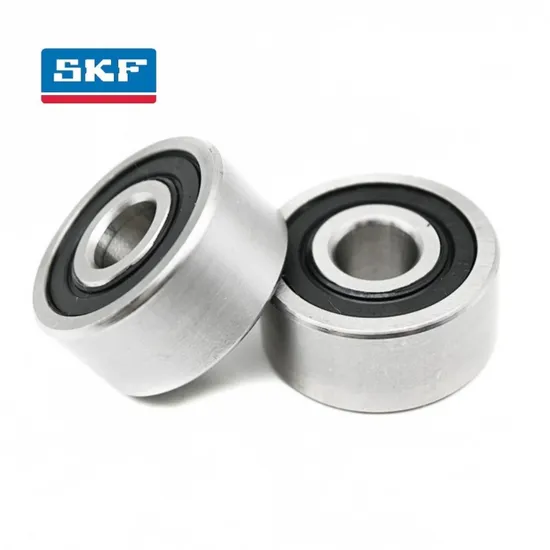
Double Row Angular Contact Ball Bearing 3306 A-2RS1 TN9/MT33 for Electric Motors with Steel Cage
<p>Ensure your electric motors run with precision and reliability using the <strong>Double Row Angular Contact Ball Bearing 3306 A-2RS1 TN9/MT33</strong>, designed to handle combined radial and axial loads with minimal friction. The steel cage construction delivers exceptional durability under continuous operation, while the 2RS1 sealing keeps contaminants out—reducing maintenance needs and extending motor lifespan.</p><ul><li>Engineered for electric motor applications where consistent performance and load capacity are critical</li><li>SKF quality assurance guarantees original factory specifications and traceable batch documentation</li><li>Precision rating ensures smooth operation even at high speeds, minimizing vibration and noise</li></ul>
View Details -
 SKF
SKF
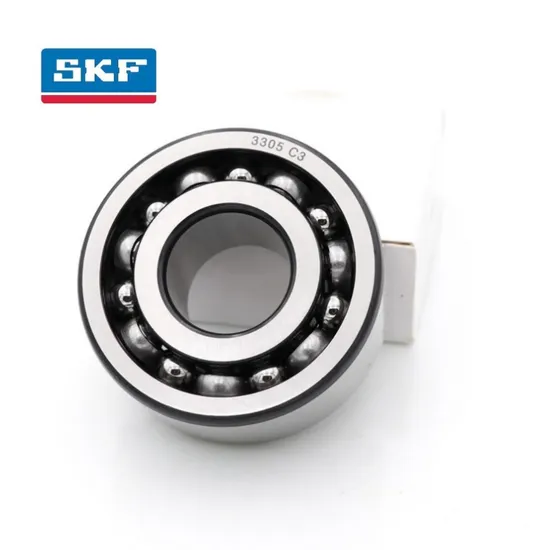
Double Row Angular Contact Ball Bearing 3310-A TN9 Nylon Cage for Machinery Applications
<p>Ensure consistent machinery performance with the reliable <strong>Double Row Angular Contact Ball Bearing 3310-A TN9 Nylon Cage</strong>, designed to handle combined radial and axial loads for smooth operation in industrial applications. SKF's precision engineering guarantees reduced vibration and extended service life, addressing the critical need for uninterrupted equipment uptime.</p><ul><li>3310-A TN9 configuration with nylon cage offers optimal heat dissipation and lower friction, ideal for high-speed rotating machinery</li><li>Double row angular contact design provides enhanced rigidity and axial load capacity compared to single row alternatives</li><li>Directly sourced from SKF official channels, ensuring 100% genuine quality with full traceability and factory warranty</li></ul>
View Details -
 SKF
SKF
Double Row Angular Contact Ball Bearing 3210 A-2RS1 Tn9/C3 for High-Precision Machinery
<p>Ensure high-precision machinery operates with exceptional stability and reduced maintenance downtime using the <strong>SKF 3210 A-2RS1 Tn9/C3</strong> double row angular contact ball bearing. Engineered to handle combined radial and axial loads in demanding applications, this bearing delivers consistent performance with its Tn9/C3 clearance and precision rating, making it ideal for critical industrial systems where reliability cannot be compromised.</p><ul><li>Double row angular contact design provides superior load distribution and rigidity compared to single row alternatives</li><li>2RS1 sealed construction ensures contamination resistance and extended service life in harsh environments</li><li>SKF's proprietary bearing steel and precision manufacturing guarantee original factory quality with complete traceability</li></ul>
View Details -
 SKF
SKF
Double Row Angular Contact Ball Bearing 3200-A-2Z TN9-MT33 for Automotive Machinery
<p>Ensure peak performance and reliability for your automotive machinery with the <strong>Double Row Angular Contact Ball Bearing 3200-A-2Z TN9-MT33</strong> from SKF. This precision-engineered bearing delivers exceptional radial and axial load handling, reducing downtime and extending equipment lifespan in critical automotive applications.</p><ul><li>SKF's TN9-MT33 cage design ensures stable operation even under fluctuating temperatures, addressing the unique stressors of automotive machinery environments</li><li>Double row construction provides 20% higher load capacity than single row alternatives, making it ideal for heavy-duty powertrain and suspension systems</li><li>2Z steel shields offer superior contamination protection, minimizing maintenance needs while maintaining consistent performance</li></ul><p>Backed by SKF's global quality assurance and our direct supply chain, this bearing guarantees 100% authenticity and traceability—so you can focus on keeping your production line running smoothly.</p>
View Details
Get a Fast Quote
Request a Quotation for
NSK 7900A5TRSUELP3 Angular Contact Ball Bearing P3 Japan
Fill in your requirements and our multilingual sales team will respond within 12 hours with a competitive price, availability confirmation and delivery schedule.
- Reply within 12 hours -- 24/7 multilingual support
- Competitive factory-direct pricing with full documentation
- Small trial orders and bulk container loads both welcome