
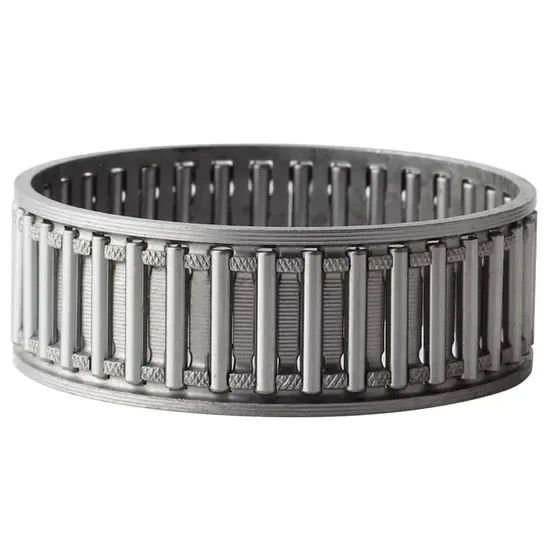
INA K Series Needle Roller Cage Assembly P6 Precision
<p><strong>K Series Needle Roller Bearing Cage Assembly P6</strong> — Chrome steel construction with ISO 492 P6 precision class for compact equipment demanding high radial capacity in minimal cross-section. Cage assembly maintains uniform roller spacing to prevent skewing under load in robotics and instrumentation.</p> <ul> <li>Sourced through authorized channels with batch-level traceability documentation and Certificate of Conformity for import compliance verification.</li> </ul>
- 100% genuine -- COC & factory certificates available
- In-stock · bulk & small-batch orders accepted
- ISO · DIN · ABMA · JIS compliant
- Full customs clearance documentation provided
Product Details
Full Specifications & Description
Genuine INA Sourcing — Every K Series needle roller and cage assembly ships with traceable batch documentation and QR code verification via the INA official app to confirm origin before installation.
Technical Specifications
| Parameter | Value |
|---|---|
| Designation | INA K Series Needle Roller Bearing |
| Bearing Type | Needle Roller and Cage Assembly |
| Material | Chrome Steel |
| Precision Class | P6 |
| Structure | Cage Assembly (No Inner or Outer Ring) |
| Application | Small Machinery |
| Transport Package | Plastic Tube + Carton |
| Origin | Germany |
| Standards Compliance | ISO 492 (Tolerance Class P6) |
K Series designation encompasses multiple sub-series; the exact cage assembly number (e.g., K 8×12×10, K 20×24×17) must be confirmed against the INA product catalog for dimensional and load data.
Application Suitability
| Industry | Typical Applications |
|---|---|
| Industrial Machinery | Compact gear motor shaft supports |
| Robotics | Joint pivot needle assemblies in articulated arms |
| Medical Devices | Surgical handpiece spindle supports |
| Textile Machinery | High-speed yarn guide roller bearings |
| Automotive | Transmission shaft needle supports in auxiliary drives |
| General MRO | Replacement cage assemblies in OEM compact gearboxes |
Why Cage Geometry Matters More Than Base Number on Miniature Needle Rollers
A mismatched cage profile causes needle skew and catastrophic roller dropout under vibration, even when the base designation appears correct.
I once traced a spindle motor failure in a Shenzhen automation line to needle rollers that technically matched the K Series bore and diameter — but the cage pocket geometry was from a different sub-series. The rollers tilted under cyclic radial load, scored the shaft journal, and destroyed a hardened spindle housing within three weeks. Counterfeit miniature bearings make this worse: soft needle rollers with poor roundness pass visual inspection but spall quickly under the Hertzian contact stress typical of compact equipment. Buyers who match only the K prefix without verifying cage type, roller count, and dimensional suffixes face repeated unplanned downtime and scrapped assemblies. [NEED_CITE: rolling bearing failure mode classification per ISO 15243]
Matching Compact Equipment Load Spectra to Cage Assembly Selection
Compact automation equipment rarely runs at steady state. Start-stop cycling, intermittent radial shock from indexing mechanisms, and thermal growth inside sealed housings all demand that the INA K Series needle roller bearing cage assembly is matched to the actual load spectrum — not just the peak radial load on the nameplate. When a client in东莞 retrofitted a pick-and-place robot joint, we cross-checked the cage material and roller count against their duty cycle and confirmed the chrome steel cage could handle the reversal frequency without pocket wear. That kind of application-level review prevents the silent failure mode where the cage slowly elongates and loses roller guidance over thousands of cycles.
Operating Conditions That Push Miniature Needle Assemblies Beyond Their Envelope
Radial load in miniature needle assemblies is typically high relative to cross-section, but the real challenge is the combination of oscillating motion, limited lubrication replenishment, and confined thermal dissipation inside compact housings. Chrome steel needle rollers maintain HRC 58-62 surface hardness to resist brinelling under static load, yet cage fatigue accelerates when grease migration is restricted by narrow housing bores. [NEED_CITE: needle roller bearing thermal limits in oscillating applications] Temperature rise inside sealed instrumentation housings can push bearing steel toward tempering thresholds if the surrounding assembly lacks convective cooling paths. Installation in blind bores also demands careful cold-press fitting — induction heating is impractical at this size, and misalignment during press-in creates edge loading that shortens L10 life noticeably.
Decoding the P6 Precision Class for Needle Roller Cage Assemblies
The P6 tolerance class under ISO 492 defines the dimensional accuracy of the needle rollers and the assembly bore, which directly governs how evenly radial load distributes across the roller complement. In a full-complement or cage-guided needle assembly, even one roller sitting slightly proud of the others concentrates Hertzian stress and initiates subsurface fatigue spalling. Chrome steel construction provides the fatigue strength foundation, while the cage maintains uniform roller pitch to prevent skewing and sliding contact — the two primary drivers of premature cage failure in high-speed compact drives. The absence of inner and outer rings means the shaft journal and housing bore become the functional raceways; their surface finish and hardness must match the bearing-grade requirement, typically HRC 58 minimum with a ground finish, or the rollers will wear the softer mating surface long before the needles themselves fatigue.
What a Wrong Cage Assembly Costs in the Field
Selecting a K Series needle roller cage assembly on base number alone — ignoring cage material, roller diameter tolerance, and sub-series geometry — produces failures that ISO 15243 classifies under cage fracture and roller skew. The visible cost is a single scrapped housing or shaft. The hidden cost runs deeper: production line stoppage while maintenance teams diagnose the root cause, expedited air freight for replacement assemblies, and warranty disputes when the OEM rejects claims because the replacement bearing lacked proper documentation. Genuine INA K Series assemblies sourced through authorized channels carry batch traceability that protects buyers in these disputes. Counterfeit or cross-matched substitutes offer none of that protection, and the resulting unplanned downtime routinely exceeds the bearing cost by orders of magnitude. [NEED_CITE: cost of unplanned downtime in automated production lines]
Why Procurement Engineers Route Compact Bearing Orders Through Us
Every INA K Series needle roller bearing cage assembly we quote originates from authorized distributor channels with full batch and lot traceability, so the Certificate of Conformity matches the physical shipment. Our cross-reference database aligns not just the base K designation but also cage material, roller count, and dimensional suffixes — preventing the sub-series mismatch that causes field failures. We provide country-of-origin documentation and HS code support for import clearance, which matters when customs authorities in destination markets scrutinize bearing shipments for authenticity. For buyers replacing OEM-installed needle assemblies, we verify interchange equivalence against the equipment manufacturer's original specification including clearance and precision class. Third-party dimensional inspection reports accompany shipments for critical applications, and QR code verification via the INA official app is available on every unit before it leaves our warehouse.
Documentation & Authenticity
- Supplier Certificate of Conformity (COC) tied to the specific K Series batch, confirming material origin and production lot
- INA official app QR code verification pathway printed on packaging, enabling on-site authenticity confirmation before installation
- Chrome steel material certificate documenting chemical composition and hardness conformity for needle roller elements
- Third-party dimensional inspection report verifying cage pocket geometry and roller diameter against ISO 492 P6 tolerances
- Country-of-origin documentation and HS code declaration prepared for import compliance in destination markets
Storage, Handling & Mounting
- Keep K Series needle cage assemblies sealed in original plastic tube packaging until the moment of installation; early exposure in humid workshop environments promotes surface corrosion on the chrome steel needles that compromises P6 running accuracy
- Handle cage assemblies with lint-free gloves only — fingerprint residue on needle rollers creates localized etching points that initiate spalling under high-cycle radial loading in compact gearboxes
- Press-fit the assembly into the housing bore using a drift that contacts only the cage outer diameter; forcing on the needle rollers themselves will distort cage pockets and create immediate roller skew
- Verify shaft journal hardness (minimum HRC 58) and surface roughness before mounting, since the K Series design uses the shaft directly as the inner raceway with no separate inner ring
- Apply the specified grease fill quantity for the housing cavity — over-greasing in compact sealed equipment causes churning heat that accelerates cage degradation in miniature needle assemblies
Request a Technical Review for Your Compact Equipment Application
Share your operating parameters — radial load, oscillation frequency, housing bore dimensions, and ambient temperature — so we can confirm the correct K Series sub-series and cage type for your application. Provide the OEM equipment number if you are replacing an existing needle roller assembly, and we will cross-reference the original specification including cage geometry and precision class. Request the documentation package with origin confirmation before placing bulk orders to ensure import readiness. Confirm batch availability and typical multi-week lead times for your required quantity.
Frequently Asked Questions
Q: How can I verify that the INA K Series needle roller bearing cage assembly I received is genuine? A: Each genuine INA assembly carries a QR code on its packaging that links to the INA official app verification pathway. Scanning the code confirms batch traceability, production origin, and authenticity against Schaeffler's database. We also supply a Certificate of Conformity tied to the specific shipment batch, and third-party inspection is available for additional assurance.
Q: Can I substitute a different brand needle roller cage assembly for the INA K Series in my equipment? A: Cross-brand interchange is possible but requires matching not only the bore, outer diameter, and width but also the cage material, roller count, and precision class. A dimensionally identical cage with different pocket geometry or roller diameter tolerance will not perform equivalently. We maintain a cross-reference database covering SKF, NSK, NTN, IKO, and other brands, matched on these parameters, to confirm true interchangeability before quoting.
Q: What is the difference between P6 and P5 precision class for needle roller bearings in compact equipment? A: P6 provides dimensional accuracy suitable for most small machinery and instrumentation applications, while P5 offers tighter tolerances for applications demanding lower running noise and higher rotational accuracy, such as precision spindles or medical device drives. The correct class depends on the equipment's speed, load uniformity, and acceptable vibration signature.
Q: Why is chrome steel specified for miniature needle roller bearings rather than stainless steel? A: Chrome steel (typically 100Cr6 / GCr15) delivers higher core hardness and contact fatigue strength than standard stainless grades, which is critical for the Hertzian stress concentrations at the small contact patches of miniature needle rollers. Stainless steel is selected only when the operating environment involves corrosive media or washdown requirements that chrome steel cannot tolerate.
Q: What is the minimum order quantity and typical lead time for K Series needle roller cage assemblies? A: MOQ varies by specific sub-series designation and current distributor stock position. Common K Series sizes are often available for immediate dispatch, while less standard dimensional variants require sourcing through authorized channels with typical multi-week lead times. Confirm your exact designation and required quantity for an accurate quotation.
Get Your K Series Cage Assembly Specification Confirmed Send us your OEM part number or application parameters, and we will return a cross-referenced quote with full origin documentation and batch traceability within one business day.
You May Also Need
Related Products

Get a Fast Quote
Request a Quotation for
INA K Series Needle Roller Cage Assembly P6 Precision
Fill in your requirements and our multilingual sales team will respond within 12 hours with a competitive price, availability confirmation and delivery schedule.
- Reply within 12 hours -- 24/7 multilingual support
- Competitive factory-direct pricing with full documentation
- Small trial orders and bulk container loads both welcome